Livpure Official Website › Notebook › Safety
Green Tea Extract And The Liver: Take It With Food
- LiverTox scores it A. The highest category: a well-established cause of clinically apparent liver injury, with more than 100 published cases.
- And it calls the rate low. “Undoubtedly low in comparison to the wide scale use of these products.” Both halves are the same page.
- Drinking tea is not implicated. The concern is the concentrated extract in capsule form.
- Take it with food. The US Pharmacopeia’s own cautionary wording. This label mentions water and says nothing about food.
The sixth name on this panel is Camellia sinensis, the tea plant. On the seller’s page it sits at the head of the second complex. It is also the one ingredient here with a safety record serious enough that the United States Pharmacopeia wrote a cautionary label for it, and that record belongs on a website selling a liver capsule more than it belongs anywhere else.
Two sentences have to travel together, and a page printing only one of them is misleading whichever it picks. Green tea extract is a well-established cause of liver injury — and the rate at which it happens is low against how widely these products are used. Both halves come from the same federal source.
Drinking tea is not the issue. The extract is.
LiverTox, the NIH database of drug-induced liver injury, is explicit that drinking green tea has not been associated with liver injury, and that population studies find regular tea drinkers have slightly lower liver enzymes rather than higher ones. The concern is the concentrated extract sold in tablets and capsules, and specifically its catechins, mostly EGCG.
The gap is a matter of amount and of how fast it arrives. The European Food Safety Authority mapped the exposure: a traditional green tea infusion supplies roughly 90 to 300 mg of EGCG a day, rising to about 866 mg for a heavy tea drinker, while supplements on the EU market supply anywhere from 5 mg to 1,000 mg a day. A cup of tea delivers its catechins slowly, alongside food and water — a capsule delivers them in one go.

What the federal record actually says
LiverTox grades ingredients by how well established a cause of liver injury they are. Green tea extract carries a likelihood score of A, the highest category, meaning a well-established cause of clinically apparent liver injury. More than 100 cases have been published. The pattern is consistent enough to describe:
- Onset is usually one to six months after starting, not on the first day.
- It usually looks like acute hepatitis when it appears.
- Most cases resolve within one to two months of stopping the product.
- Fatal acute liver failure has been described.
None of that is a rumour or a competitor’s scare story. It is the National Institutes of Health describing a documented pattern in a public database.
And the same page calls the risk low
The second half is on the same LiverTox page, and it is quoted here in full because leaving it out would be the mirror image of the failure above. The rate of symptomatic injury, LiverTox says, “is undoubtedly low in comparison to the wide scale use of these products”.
Green tea extract sits in an enormous number of supplements sold in enormous quantities. Against that denominator, a hundred published cases is a small number. Neither sentence cancels the other. Together they describe a small, real risk worth managing rather than either ignoring or panicking about.
| What the record shows | The source | What it does not mean |
|---|---|---|
| Likelihood score A, the highest category | LiverTox | Not that any particular product will injure you. |
| More than 100 published cases | LiverTox | Not a rate. Nobody knows the denominator. |
| Rate is “undoubtedly low” against how widely it is used | LiverTox | Not that the risk is zero, or that score A is overstated. |
| Onset 1–6 months, usually resolves 1–2 months after stopping | LiverTox | Not a guarantee of recovery. Fatal cases exist. |
| Drinking tea is not associated with injury | LiverTox | Not that the extract is equally safe. |
| Susceptibility varies between people | NCCIH and USP | Not that a small amount is therefore safe for everyone. |
Why it happens to some people and not others
The injury is described as idiosyncratic, meaning it does not follow the usual dose curve where more of something reliably produces more harm. The amount that is completely uneventful for almost everyone is not uneventful for a few.
Part of the reason appears to be genetic. NCCIH records that people carrying a particular immune-gene variant are markedly more susceptible to green tea extract liver injury, and that 5 to 15 percent of Americans carry it. There is no consumer test for it and nobody knows in advance which group they are in — which is precisely why “it is only a small amount” is not a safety argument.
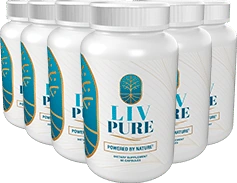
Livpure on the official website
Six named ingredients, 60 capsules a bottle, $49 to $79 a bottle and 60 days to send it back, empty bottles included.
Order LivpureThe numbers that exist
Three sources carry real figures, and they are worth having in front of you because they are the only quantities in this whole subject.
A year-long trial, in 1,075 women
The Minnesota Green Tea Trial gave 1,075 postmenopausal women 843 mg of EGCG a day for one year. ALT rose above the normal range in 6.7 percent of the women taking the extract, against 0.7 percent on placebo. No clinically apparent injury occurred, and when the extract was restarted in women whose enzymes had risen, the enzymes rose again. ALT is alanine transaminase, one of the enzymes a liver function test measures; a rise means liver cells are releasing it into the blood, and it is the earliest ordinary signal that something is irritating the organ.
A regulator’s threshold
EFSA reviewed the interventional trials and concluded that 800 mg of EGCG a day or more, taken as a food supplement, produced a statistically significant rise in serum transaminases. That is a European opinion rather than a United States one, and it is quoted here as such.
Where the published injuries start
The US Pharmacopeia’s 2020 systematic review found published case reports spanning EGCG intakes from roughly 140 mg to 1,000 mg a day. That bottom figure is the one that changes how you read a small dose. The review’s own conclusion is not that there is a safe threshold; it is that susceptibility varies between people.
| Figure | Where it comes from | On the Livpure label |
|---|---|---|
| 843 mg EGCG a day for a year | Minnesota Green Tea Trial | Not published |
| 800 mg EGCG a day and above | EFSA transaminase threshold | Not published |
| About 140 mg to 1,000 mg a day | USP review of published injury cases | Not published |
| 90–300 mg a day from brewed tea | EFSA exposure estimate | Not applicable |
| Amount of Camellia sinensis per capsule | No published figure exists | Not published |
No milligram figure is printed for any ingredient in Livpure, so no row above can be set against a Livpure number. The research doses are printed here and the label’s silence beside them.
What this label prints, and what it leaves out
Livpure names Camellia sinensis as one of its six named ingredients. It publishes no amount for it, no EGCG figure, no extract ratio and no standardisation percentage. That means nobody, this desk included, can say where a capsule falls in the range above. It could be well under 140 mg a day. Nobody has printed the number that would settle it.
The seller’s only direction for taking it is to take it daily with a large glass of water. The bottle prints 60 capsules and the seller sells that bottle as a thirty-day supply, which is two capsules a day as arithmetic rather than as an instruction. The directions printed on the bottle you receive are the ones that govern, and how to take it is set out here.
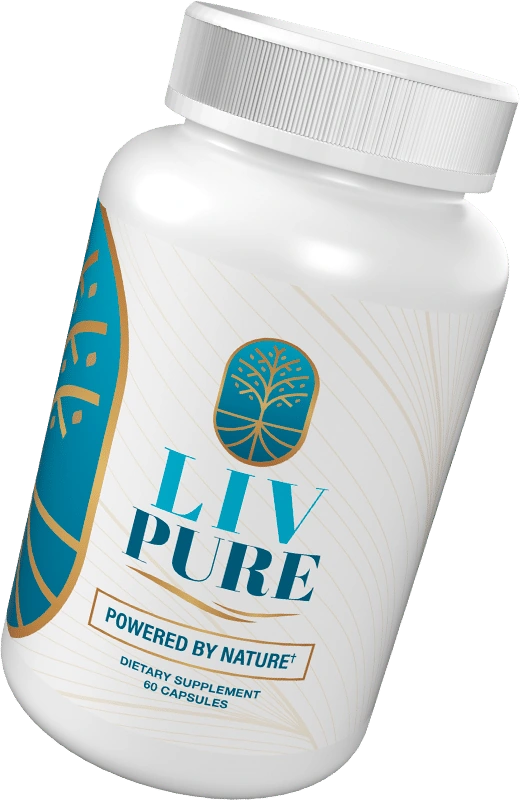
The one instruction worth following: take it with food
This is the practical end of the whole subject, and it is better than five repetitions of a general warning. The USP review found that taking green tea extract on an empty stomach sharply increases how much catechin is absorbed, and that is why USP added a cautionary statement to its own green tea extract monograph: do not take on an empty stomach, take with food.
That is a real, specific, free thing a buyer can do, it costs nothing, and it works on the only mechanism anyone has identified. USP’s cautionary labelling carries a second line with it, which is that the extract should not be used by anyone who already has a liver problem. That is the opposite of the way a liver supplement is usually sold, and it is the position of the body that writes the monograph.
Take it with food rather than on an empty stomach, and do not take it at all if you have a diagnosed liver condition. Both of those are the US Pharmacopeia’s own cautionary wording rather than this desk’s advice.
Two medicines this extract is known to touch
NCCIH names two interactions specifically, and one more thing worth counting:
- Atorvastatin. Green tea extract reduces its blood levels.
- Raloxifene. An NCCIH-funded study found an interaction.
- Caffeine. Green tea is a source of it, which matters to anyone keeping a daily total.
Berberine, the third name on this panel, carries a longer list, and it has its own article rather than a line in a table here. Between them, two of the six named ingredients have documented interactions with prescribed medicine, which is the substance behind the sentence below.
Livpure is a dietary supplement sold to support liver health. It is not a treatment for hepatitis, fatty liver disease, cirrhosis or any other liver condition, and it should not be used to manage one. If you take a prescription, are pregnant or nursing, or have a liver condition of any kind, the conversation to have with a clinician before the first capsule is about green tea extract and berberine specifically, and it is worth bringing the bottle. Yellowing of the skin or eyes, dark urine, pale stools, unusual tiredness, nausea or pain under the right ribs while taking any supplement are reasons to stop it and be seen.
What to do with all of this
A website that earns money on the order is the last place to pretend there is a clean recommendation here. What this desk can do is set the decision out properly.
- The risk is real, documented by the NIH, and small.
- Nobody can tell you in advance whether you are in the susceptible group.
- The amount in this capsule is not published, so it cannot be compared with the numbers above in either direction.
- Taking it with food is free and addresses the one mechanism anyone has identified.
- Onset runs one to six months — inside the window the 60-day guarantee covers, and then past it.
- If you already have a liver problem, the US Pharmacopeia’s own cautionary label says this is not for you.
Anyone who wants the rest of the safety picture will find what is documented for all six ingredients here, and who this is genuinely wrong for here. Neither of them softens this section.
Sources cited in this article
- National Institute of Diabetes and Digestive and Kidney Diseases. Green Tea. In: LiverTox: Clinical and Research Information on Drug-Induced Liver Injury. Bethesda (MD): NIDDK; 2012-. https://www.ncbi.nlm.nih.gov/books/NBK547925/
- Oketch-Rabah HA, Roe AL, Rider CV, et al. United States Pharmacopeia (USP) comprehensive review of the hepatotoxicity of green tea extracts. Toxicol Rep. 2020;7:386-402. https://pubmed.ncbi.nlm.nih.gov/32140423/
- Dostal AM, Samavat H, Bedell S, et al. The safety of green tea extract supplementation in postmenopausal women at risk for breast cancer: results of the Minnesota Green Tea Trial. Food Chem Toxicol. 2015;83:26-35. https://pubmed.ncbi.nlm.nih.gov/26051348/
- EFSA Panel on Food Additives and Nutrient Sources added to Food (ANS). Scientific opinion on the safety of green tea catechins. EFSA J. 2018;16(4):e05239. https://pubmed.ncbi.nlm.nih.gov/32625874/
- National Center for Complementary and Integrative Health. Green Tea: Usefulness and Safety. https://www.nccih.nih.gov/health/green-tea
- MedlinePlus, U.S. National Library of Medicine. Liver Function Tests. https://medlineplus.gov/lab-tests/liver-function-tests/
 Sixty days from the day you buy it