Livpure Official Website › Notebook › Safety
Berberine And Prescription Medicines: What To Check First
- Three enzymes, one study. 900 mg of berberine a day for two weeks slowed CYP3A4, CYP2D6 and CYP2C9 in healthy men.
- Midazolam exposure rose 40%. And the dextromethorphan ratio rose ninefold. The authors say interactions should be considered.
- Cyclosporine is named. NCCIH names it specifically, and also warns about infants, pregnancy and breastfeeding.
- Molybdenum is the quiet one. The NIH says it has no known clinically relevant medicine interactions.
Berberine is the third name on this panel and it has the longest interaction record of the six. That is not a reason to avoid it. It is a reason to know what the record says before the first capsule rather than afterwards, and it is short enough to read in one sitting.
What follows names the enzymes, the study, the dose that produced the effect and the medicines the sources themselves name. It does not tell you to ask someone five times. It tells you what to ask about.
What berberine is, and what it is not
Berberine is an alkaloid — a bitter yellow compound drawn from barberry, goldenseal and a number of other plants. It has a long history in traditional use and a substantial modern research record, most of it about blood glucose.
LiverTox records the usual amount in herbal products as 250 to 500 mg taken two or three times daily, describes side effects as mostly mild gastrointestinal ones, and gives berberine a likelihood score of E for liver injury, meaning it has not been linked to clinically apparent injury. The same entry is explicit that berberine has not been approved for any of its marketed uses in the United States.

The enzymes that clear your prescriptions
Most medicines are broken down by a family of liver enzymes called the cytochrome P450 group. Three of them do a large share of that work: CYP3A4, CYP2D6 and CYP2C9. When one of those enzymes is slowed down, the medicines it clears leave the body more slowly, so the level in the blood rises. Nothing about the prescription has changed — the clearance has.
Guo 2012 measured exactly that. Healthy men took 300 mg of berberine three times a day, 900 mg in total, for two weeks. All three enzymes showed reduced activity. Exposure to midazolam, the probe drug used to read CYP3A4, rose by 40 percent, and the dextromethorphan ratio used to read CYP2D6 rose ninefold. The authors’ own conclusion is that drug interactions with berberine should be considered.
A 40 percent rise is not a curiosity. For a medicine with a wide safety margin it may mean nothing at all — for one whose dose has been tuned carefully, it is the kind of change a prescriber would want to know about.
| What was given | What was measured | What happened |
|---|---|---|
| Berberine 300 mg three times a day, for two weeks | CYP3A4 activity, read with midazolam | Midazolam exposure rose 40% |
| The same 900 mg a day | CYP2D6 activity, read with dextromethorphan | The ratio rose ninefold |
| The same 900 mg a day | CYP2C9 activity | Activity reduced |
| Healthy male volunteers | Not patients on treatment | The authors say interactions “should be considered” |
Guo 2012, in healthy volunteers. No amount of berberine is published for Livpure, so nobody can say how far below 900 mg a day a capsule sits, or whether it does.
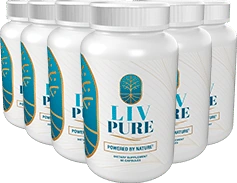
Livpure on the official website
Six named ingredients, 60 capsules a bottle, $49 to $79 a bottle and 60 days to send it back, empty bottles included.
Order LivpureWhich prescriptions this actually touches
This is where most supplement pages go vague. The sources name specific things, so this page names them.
- Cyclosporine. NCCIH names it specifically as a medicine berberine interacts with. It is an immunosuppressant, and its blood level is monitored precisely because small changes matter.
- Midazolam, a benzodiazepine, is the drug the Guo study used to read CYP3A4, and its exposure rose 40 percent. It stands in for the wider group of medicines that enzyme clears.
- Dextromethorphan, the cough suppressant used to read CYP2D6, showed a ninefold change in ratio.
- Anything else cleared by those three enzymes. CYP3A4 in particular handles a large share of prescription medicines. A pharmacist can tell you in under a minute whether yours is one of them; a supplement website cannot, because it does not know what you take.
That last line is the honest boundary of this article. The mechanism is documented and the list of medicines that run through those enzymes is long, specific and not something to recite from memory on a sales website.
Berberine and blood sugar
The largest berberine literature is not about the liver at all. A 2021 meta-analysis of 46 randomised trials found reductions in HbA1c, fasting glucose and post-meal glucose in people with type 2 diabetes. Trial doses in that literature run roughly half a gram to a gram and a half a day, commonly 500 mg two or three times daily.
Three things follow, and the third is the one that matters here:
- It is a glucose meta-analysis in diagnosed diabetes, so it says nothing about the liver and nothing about people without diabetes.
- It is not a claim this website makes about Livpure, which publishes no berberine amount.
- An ingredient that lowers blood glucose, taken alongside a prescribed medicine that also lowers blood glucose, is a combination whose prescriber should know it is happening.
NCCIH adds a separate finding on the other reason berberine is marketed: effects on weight appeared mainly in people taking more than a gram a day for more than eight weeks, and many of those studies carried a high risk of bias. NCCIH’s own conclusion is that the evidence is not conclusive. No amount is published here, so that literature has nothing to attach itself to.
Infants, pregnancy and breastfeeding
This is the clearest safety statement in the whole of the berberine record, and it is unambiguous. NCCIH states that berberine has been linked to a harmful buildup of bilirubin in infants, that it is likely to be unsafe for infants, and that it may also be unsafe during pregnancy or while breastfeeding.
Livpure is sold for healthy adults aged 18 and over and is not for anyone pregnant or nursing, which the footer of every page on this website says. The berberine record is the specific reason behind that general sentence.
The second interaction on this panel
Berberine is not the only name here with a documented interaction. NCCIH’s green tea page records that green tea extract reduces blood levels of atorvastatin, and that an NCCIH-funded study found an interaction with raloxifene. Green tea is also a source of caffeine.
The green tea extract on this panel carries a liver safety record of its own, which is a longer subject and has its own article. Two of six named ingredients with documented interactions is the real count on this label, and it is worth knowing before rather than after.
The quiet one on the panel
A safety section that lists only hazards is as unbalanced as one that lists none, so this one goes the other way as well. NIH ODS states plainly that molybdenum has no known, clinically relevant interactions with medications. It sets an adult RDA of 45 micrograms a day and a tolerable upper intake level of 2,000 micrograms a day, which are the only hard numbers on this entire panel.
Molybdenum deficiency is also essentially unknown in people eating ordinary food — legumes are rich in it — so a supplemental amount is not filling a common gap. The label publishes no figure for it either, which means it cannot be checked against that 2,000 microgram ceiling any more than anything else here can.
One conversation, and what to bring to it
This does not need to be a habit, a worry or a series of appointments. It is one exchange, it takes a couple of minutes, and it settles the question for the whole 60-day window.
- Take the actual bottle, not a screenshot. The names on it are what matters.
- Say the two words that do the work: berberine and green tea extract.
- Say that no amount is printed for either, because that changes the answer you get.
- Bring your current prescription list, including anything taken occasionally.
- Ask specifically about anything cleared by CYP3A4, and about anything that lowers blood glucose.
Livpure is a dietary supplement, not a treatment for any liver condition and not a substitute for prescribed medicine. Nothing here is a reason to change or stop a prescription. If you take one, the pharmacist who dispenses it is the person best placed to answer this in a minute, and the two names to give them are berberine and green tea extract.
| If you take | Why it matters | What to do |
|---|---|---|
| Any prescription medicine | Berberine slowed CYP3A4, CYP2D6 and CYP2C9 at 900 mg a day | Show the bottle to a pharmacist |
| Cyclosporine | Named specifically by NCCIH | Ask the prescriber before starting |
| Medicine for type 2 diabetes | Berberine lowered glucose across 46 trials | Ask the prescriber before starting |
| Atorvastatin or raloxifene | Green tea extract interacts with both | Ask the pharmacist about the extract as well |
| Nothing prescribed, and not pregnant or nursing | The interaction question does not arise | Follow the directions printed on the bottle |
If you take nothing prescribed
Then most of this article is background rather than instruction. The berberine record is reassuring on the liver specifically, its documented side effects are mild and digestive, and the interaction question needs something to interact with.
The remaining caution is the one that applies to everyone: no amount is published, so the research doses above cannot be matched to this capsule in either direction. That is the subject of the article on this label, and what is documented for all six ingredients is here.
Sources cited in this article
- Guo Y, Chen Y, Tan ZR, Klaassen CD, Zhou HH. Repeated administration of berberine inhibits cytochromes P450 in humans. Eur J Clin Pharmacol. 2012;68(2):213-217. https://pubmed.ncbi.nlm.nih.gov/21870106/
- National Center for Complementary and Integrative Health. Berberine and Weight Loss: What You Need To Know. https://www.nccih.nih.gov/health/berberine-and-weight-loss-what-you-need-to-know
- National Institute of Diabetes and Digestive and Kidney Diseases. Berberine. In: LiverTox: Clinical and Research Information on Drug-Induced Liver Injury. Bethesda (MD): NIDDK; 2012-. https://www.ncbi.nlm.nih.gov/books/NBK564659/
- Guo J, Chen H, Zhang X, et al. The Effect of Berberine on Metabolic Profiles in Type 2 Diabetic Patients: A Systematic Review and Meta-Analysis of Randomized Controlled Trials. Oxid Med Cell Longev. 2021;2021:2074610. https://pubmed.ncbi.nlm.nih.gov/34956436/
- National Center for Complementary and Integrative Health. Green Tea: Usefulness and Safety. https://www.nccih.nih.gov/health/green-tea
- NIH Office of Dietary Supplements. Molybdenum: Fact Sheet for Health Professionals. https://ods.od.nih.gov/factsheets/Molybdenum-HealthProfessional/
 Sixty days from the day you buy it