Livpure Official Website › Notebook › Label literacy
Two Complexes, No Milligrams: How To Judge This Label
- A blend total is a ceiling. Nothing inside a blend can weigh more than the whole, which is why the total is the number that matters.
- Neither complex has one. No weight is published for either group, and no amount for any of the ten names.
- Two capsules carry everything. Sixty capsules sold as thirty days is two a day, and those two hold all ten names between them.
- The checks that survive. Count, form, price a day, the guarantee window, the interactions and the lot code.
Most supplement labels tell you less than they appear to. This one tells you less than that. The seller’s page groups ten ingredient names into two proprietary complexes, prints no amount beside any of the ten, and prints no total for either complex. The supplier’s own listing artwork names six of those ten and also stops at the names.
So the question this article answers is a practical one. If no number is published anywhere, what is actually left for a buyer to check, and how far does it get you? The answer is further than it looks, and it stops well short of a dose.
What a proprietary blend is, and what it still tells you
A proprietary blend is a lawful arrangement on a Supplement Facts panel. The manufacturer lists the ingredient names inside the blend, gives one combined weight for the group, and does not have to split that weight between them. It is the least informative arrangement the rules allow — and it exists to keep a formula from being copied.
Even so, a blend total does real work, and it is worth being precise about why:
- A total is a ceiling. If a blend weighs 400 mg, no single ingredient inside it can weigh more than 400 mg, and usually it weighs a great deal less.
- The order is information. Ingredients inside a blend are listed by weight, heaviest first, so the name at the end of the list is the smallest amount in it.
- A ceiling can settle a purchase. If a research dose is two grams and the whole blend is four hundred milligrams, the blend is not delivering that dose and no further argument is needed.
Here there is not even a total
The two group names the seller uses are the Liver Purification Complex and the Liver Fat-Burning Complex. Neither is a Supplement Facts heading and neither carries a weight. There is no published Supplement Facts panel for this product online at all, and this desk has not been shown one.
That removes the ceiling — without a total there is no number that anything must be smaller than, and the order of names inside a group cannot be read as a weight order when no weight is declared for the group at all.
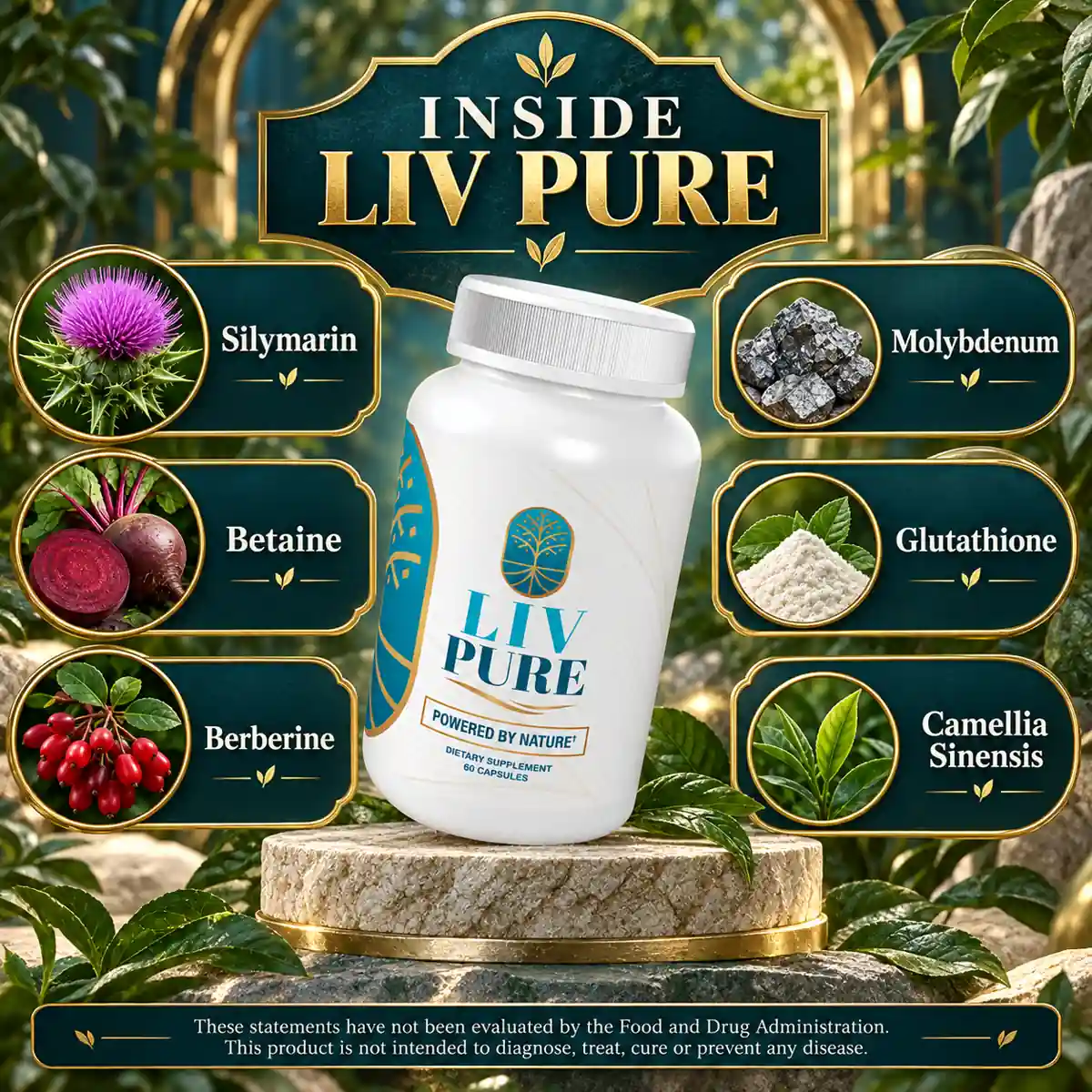
Six names on the panel, ten on the sales page
The supplier names silymarin, betaine, berberine, molybdenum, glutathione and Camellia sinensis. Those six appear in the paperwork behind this desk and on the supplier’s own listing artwork, which is two independent statements agreeing, and it is why they are the panel this website publishes on the ingredients page.
The seller’s page adds four more and sorts all ten into the two complexes. The four extras are carried here as the seller’s longer list, labelled as the seller’s, and not asserted as the formula.
| On the supplier’s panel | Added by the seller’s page | Amount published |
|---|---|---|
| Silymarin | Resveratrol | Neither |
| Betaine | Genistein | Neither |
| Berberine | Chlorogenic acid | Neither |
| Molybdenum | Choline | Neither |
| Glutathione | — | Neither |
| Camellia sinensis | — | Neither |
The supplier’s six are the panel this desk publishes. The four on the right appear on the seller’s page only, and the difference is stated once here and once on the home page rather than repeated on every surface.
The one piece of arithmetic that is available
One number can be worked out honestly, and it comes from the label itself rather than from an estimate. The bottle holds 60 capsules and the seller sells that bottle as a thirty-day supply. Thirty days into sixty capsules is two capsules a day.
That is arithmetic from the seller’s own supply claim, not a serving size, and the directions printed on the bottle you receive are what decide. But it is enough to fix the scale of the problem: two capsules a day have to carry all ten named ingredients between them. A capsule of ordinary size holds a few hundred milligrams of powder, and ten ingredients sharing that space is the constraint every dose comparison below runs into.
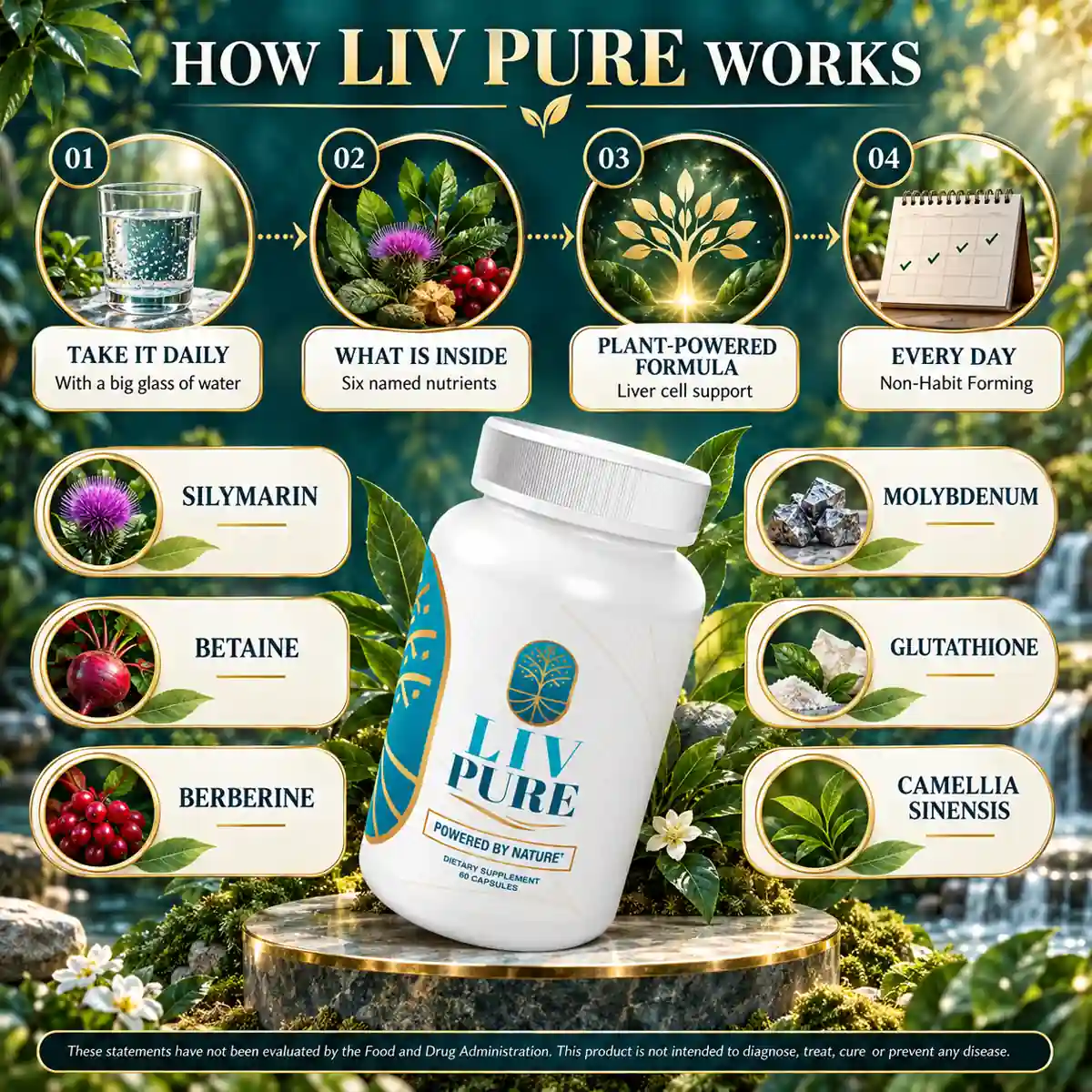
Livpure on the official website
Six named ingredients, 60 capsules a bottle, $49 to $79 a bottle and 60 days to send it back, empty bottles included.
Order LivpureWhat the research doses look like beside a blank
Every comparison on this website is a published research dose set against “not published”, because there is no Livpure figure to compare with. Written out that way, the table is still useful, because several of these doses are physically out of reach of two capsules whatever the split inside them.
| Ingredient | What the research used | On the Livpure label |
|---|---|---|
| Silymarin | 1,260 mg or 2,100 mg a day for 24 weeks in the SyNCH trial, and neither dose beat placebo | Not published |
| Betaine | 1.5 g, 3 g and 6 g a day for six weeks in Olthof 2003; ordinary food supplies 0.5–2 g a day | Not published |
| Molybdenum | NIH ODS gives an adult RDA of 45 mcg a day and an upper limit of 2,000 mcg a day | Not published |
| Glutathione | A single 3 g oral dose did not raise blood glutathione at all in Witschi 1992 | Not published |
| Camellia sinensis | Published liver-injury cases span about 140 mg to 1,000 mg of EGCG a day | Not published |
None of these studies involved Livpure. They are studies of single ingredients, several of them negative, and they are printed here for the amounts and the results rather than as evidence about this capsule.
Three readings come out of that table, and they point in different directions. The silymarin dose is out of reach of two capsules, and it also did not work, which is the more useful half of the sentence. The betaine range is one an ordinary diet already supplies. Glutathione’s problem is not the dose at all but absorption, so a milligram figure would not settle much even if one were printed. Molybdenum is the single ingredient with a published ceiling, and the label gives no figure to check against it.
What a buyer can still check
More than the section above suggests. None of these is a dose, and all of them are real.
Things printed on the bottle
- The capsule count, 60, and therefore the number of days at the seller’s own supply claim.
- The form: capsules, not a gummy, a tablet or a liquid.
- The four lines on the front, which carry no claim between them.
- The lot code, LIV-26/GE-7267, and the certificate reference, LIV-7267-26-GE. Both are label references rather than a laboratory report this desk has read, and what a lot code can and cannot tell you is here.
Things you can work out yourself
- Cost a day, from the pack price and the bottle’s own supply claim.
- Whether the supply you buy outlasts the 60-day guarantee window, which the six-bottle pack does by four months.
- Whether any named ingredient interacts with something you already take.
- Whether the seller’s page claims anything the printed label does not.
What a better version of this label would print
This is not a wish list. Every row below appears on labels that already exist, and any one of them would change what a buyer could conclude.
- A Supplement Facts panel, published online. The physical bottle carries one; a photograph of it on the product page costs nothing.
- A milligram figure per ingredient, or failing that a weight for each complex, which would at least restore the ceiling.
- A standardisation percentage for the extracts. Silymarin content for the milk thistle, EGCG content for the green tea. Those two numbers carry more information than the rest of the label combined.
- The plant part used, seed or leaf or root, for each botanical.
- A serving size in capsules, and servings per container, which would make the thirty-day claim checkable instead of inferred.
- The capsule shell and an allergen statement, which would let the vegetarian and gluten-free seals be verified rather than taken on trust.
FDA’s own framing is worth remembering here: a structure/function claim is notified rather than approved, so no regulator has read the words on this page and agreed with them. The panel is the part of a label that is checkable, and it is the part that is missing.
Why this matters more on a liver product than on most
LiverTox’s overview of herbal and dietary supplements records that supplements are a recognised cause of drug-induced liver injury, and sets out how such a case is assessed. Assessment starts with what the person took and how much of it. An undeclared amount is a gap in the first line of that record, and on a product whose panel includes green tea extract it is the gap worth caring about: the green tea article is the reason this one exists.
Livpure is a dietary supplement, not a treatment for any liver condition. Because no amount is published for any ingredient, a pharmacist cannot check a dose for you either — but they can still tell you whether berberine or green tea extract interacts with something you are prescribed, and that is the conversation worth having before the first capsule. Symptoms such as yellowing skin or eyes, dark urine or ongoing pain under the right ribs are reasons to be seen by a clinician rather than to change a supplement.
What to do about a label with no numbers on it
Buy it or do not, but buy it knowing what you are not getting. A label with no amounts is not evidence of a bad formula — it is the absence of evidence either way. What it means is that the only things you can weigh are the ones listed further up: the names, the count, the price a day, the guarantee and the seller’s conduct on everything else.
This desk suggests three bottles rather than six for a first order, and the reason is exactly this uncertainty: ninety days covers the wait buyers describe and still leaves capsules in hand when the refund window shuts, without committing six months of money to a formula nobody has published. The desk earns more on six, and says so.
Sources cited in this article
- U.S. Food and Drug Administration. Structure/Function Claims. https://www.fda.gov/food/nutrition-food-labeling-and-critical-foods/structurefunction-claims
- Fried MW, Navarro VJ, Afdhal N, et al. Effect of silymarin (milk thistle) on liver disease in patients with chronic hepatitis C unsuccessfully treated with interferon therapy: a randomized controlled trial. JAMA. 2012;308(3):274-282. https://pubmed.ncbi.nlm.nih.gov/22797645/
- Olthof MR, van Vliet T, Boelsma E, Verhoef P. Low dose betaine supplementation leads to immediate and long term lowering of plasma homocysteine in healthy men and women. J Nutr. 2003;133(12):4135-4138. https://pubmed.ncbi.nlm.nih.gov/14652361/
- NIH Office of Dietary Supplements. Molybdenum: Fact Sheet for Health Professionals. https://ods.od.nih.gov/factsheets/Molybdenum-HealthProfessional/
- Witschi A, Reddy S, Stofer B, Lauterburg BH. The systemic availability of oral glutathione. Eur J Clin Pharmacol. 1992;43(6):667-669. https://pubmed.ncbi.nlm.nih.gov/1362956/
- National Institute of Diabetes and Digestive and Kidney Diseases. Herbal and Dietary Supplements. In: LiverTox: Clinical and Research Information on Drug-Induced Liver Injury. Bethesda (MD): NIDDK; 2012-. https://www.ncbi.nlm.nih.gov/books/NBK548441/
 Sixty days from the day you buy it